
There is a quiet, uncomfortable shift happening inside many modern families. Look closely at how many parents and adult children interact today, and you start to see something that looks less like unconditional love and more like a barter system. There is little patience, little genuine trust in a simple conversation, and often, a striking lack of basic respect.
People often blame exhaustion or busy schedules for this distance. Yet, when you look closer, it is rarely about tiredness. The problem lies elsewhere, and it comes down to two stark realities. One, a poramboku attitude – worthless attitude. Two a modern tool to manage the relationship.
1. Viewing Elders as an Inconvenience
For many young and middle-aged adults, aging parents are quietly categorized as “problems”—synonymous with extra work, unsolicited advice, or disruption to a curated lifestyle. The unspoken strategy becomes simple: keep them at bay to avoid trouble.
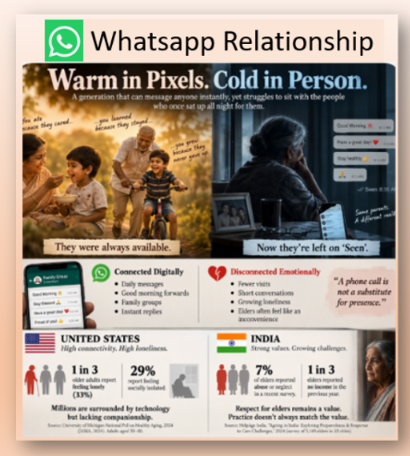
2. The “WhatsApp Relationship”
This trend has been building for years, though many innocent mothers and fathers are only just beginning to recognize it for what it is.
It starts innocently enough—a family WhatsApp group with sons, daughters, and parents. Every day brings a predictable stream of Good Morning and Good Night messages, punctuated by Happy Diwali or Happy New Year greetings. For a parent, this feels like connection. It feels like being remembered.
And then, the parents visit in person.
Suddenly, the warmth vanishes. There is no real welcome at the door. No “Will you have something to eat?” No small, thoughtful gestures of care. The arrival is cold, and that chill sets the tone for the entire stay.
Driven by deep love for their children, parents hang on. For years.
They hold onto the hope that things will thaw, much like the old days when a scolded, sulking child would eventually soften and come back for a hug.
Days pass in quiet tension. The children silently count down the hours until their parents leave. The parents pack their bags, lingering just a little, hoping their children will show a flicker of real affection before goodbye—something warm to carry home in their hearts.
As adult children grow accustomed to this routine, their guilt fades. The coldness deepens into dodged questions, curt replies, and emotional distance.
Then, right as the departure day nears, a subtle shift happens. The tone softens. Responses become slightly kinder and gentler—just enough to keep the peace, prevent any emotional confrontation, and ensure the parents leave smoothly and on schedule.
At first, parents mistake this sudden send-off politeness for a return to normalcy. Only later do they realize it was simply an act to manage the exit.
The moment the parents reach home, the digital affection resumes right on cue.
The WhatsApp love starts flowing again. If the parent realizes the reality and stops messaging this is used a bad etiquette!!
The adult children return to their busy lives and personal pleasures, completely unbothered.
The first time a parent experiences this contrast, it feels shocking and deeply hurtful. Over the years, however, they simply get used to the hollowness of it.
Of course, there are two notable exceptions to this rule: when parents are wealthy enough to offer financial leverage,

or when the children need them to step in as free nannies and babysitters.

Outside of those transactions, the relationship stays neatly confined to a phone screen.
That, in short, is the modern WhatsApp relationship—
Warm in Pixels, Cold in Person.