
A NOTE for Immigrants particularly, Hindu Indians.
The United States is a vast land—open stretches running hundreds of miles, some accessible by road, many not. With a landmass three times the size of India and only a third of its population, the country’s geographic sprawl creates a unique vulnerability: isolation. In remote areas, help isn’t always close.
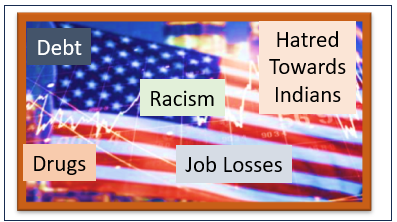
This persistent threat has shaped one of America’s most controversial realities—
1: GUNS.
🔫 Guns: Protection or Peril
Guns are a sensitive topic. They are both a symbol of personal freedom and a source of national trauma. While firearms are responsible for countless violent crimes and the deaths of innocent people, they are also seen as a necessary means of protection—especially in areas where law enforcement may be hours away.
But this duality is dangerous. Guns give immense power to individuals, enabling them to terrorize dozens, even hundreds, at a time. The threat isn’t theoretical—it’s constant. Citizens live with the knowledge that anyone, anywhere, could be armed and unpredictable.
🌿 Drugs: Legalization or Surrender
The second issue is drugs—particularly marijuana. Once tightly controlled, marijuana is now freely available in much of the country. Unable to contain its spread, many states have opted to legalize it.
As of 2025, recreational marijuana is legal in 24 states plus Washington, D.C., while medical marijuana is permitted in most others. This patchwork of laws reflects a broader struggle: how to balance regulation, public health, and economic opportunity. Legalization has brought tax revenue and jobs, but also normalization of substance use—raising questions about long-term societal impact.
🏚️ Serial Squatting: A Symptom of Societal Breakdown
Perhaps the most telling sign that the American dream is fraying is the rise of serial squatting.
🚨 A Growing Crisis
- Legal Loopholes: In many states, squatters can exploit adverse possession laws, claiming rights to a property after occupying it for a set period (typically 5 to 21 years) and paying property taxes.
- Eviction Delays: Courts in states like New York and Illinois are slow to act. Squatters are often treated as tenants, even without a lease, making removal a drawn-out legal battle.
- Airbnb Exploits: Short-term renters who stay beyond 30 days can invoke tenant protections, complicating eviction and emboldening abuse.
- Organized Abuse: Syndicates now scout for vacant homes, forge fake leases, and use legal ambiguity to stall eviction. Once removed, they simply move on to the next target—creating a cycle of exploitation.
What’s most disturbing is the mindset: squatters operate with impunity, often boasting about how easily they can manipulate the system. The law, slow and lenient, offers little deterrence.
For Indian immigrants who aspire to build a stable life—working hard, paying taxes, and sending their children to good schools—this is a serious warning.
These goals depend on a society that respects property rights and enforces the rule of law. Serial squatting reveals a breakdown in that social contract.
If long-established Americans are struggling to protect their homes, imagine the vulnerability of immigrants earning below the $100,000 threshold. Many end up in middle-class neighborhoods, often surrounded by fellow South Asians. And if that’s the reality—if safety, dignity, and stability are compromised—one must ask: why endure the hardship of migrating to the U.S. at all?
2. Caught in the Racism Crossfire
Let us face it. Racism in USA is rampant.
In the short period I was in that Country, I faced several such instances. Go to an empty restaurant, occupy and watch how the distribution is as it fills up. Your adjacent tables are the last ones to fill up. Go to a public toilet, men hate to pee in the cubicle next to you.
Same in classes in College.
It is like this. Whites hate Blacks when there are only themselves in a Large group. In fact, if there is a crime, common Americans first assume that it must be a Black who has committed the crime.
If in a large Group, there are Indians, Whites, and Blacks, then Whites prefer talking with Blacks. Blacks do not prefer Indians.
So, everyone hates Indians. Physically, shorter and slimmer (perceived as weak by the common man), working hard and earning money (like the early immigrants!), marrying and living in a group (by and large) creating their own Mini India. A sure shot recipe for easy targeting an isolation.
If a white Italian were to immigrate to US, he would easily merge into the white society even though his food habits and accent would be as diverse as an Indian’s would be.
3. Women’s Promiscuity.
It is wrong to ascribe that US is a land of freedom in a puritan sense. While conservative Europe was restrictive, the people who left those lands and migrated to US, were adventurists, who sought success with hard work and Freedom from restrictive societies or families.
Over the years the US evolved into a state where women’s promiscuity is being increasingly viewed as Freedom.
This has resulted in a situation wherein men do not bother about marrying, having children, and leaving the wife and children to fend for themselves.
And, there is neutral social sanction for such men.
In societies like India such behavior results in several social reprimand that those in the near proximity will think several times before doing and repeating such a thing. Where do the men get the license to do such things? Women’s promiscuity. While unscrupulous men find it easier to just leave such marriages most Women do not leave her children. Mother’s love.
- Commitment erosion: When freedom is absolute, responsibility becomes optional.
- Family instability: The normalization of transient relationships has weakened long-term bonds.
- Social sanction: In many circles, independence is celebrated even when it leads to neglect — of partners, children, or community.
While writing about men who leave women after marrying, I am reminded of seeing a few single mothers in an apartment complex where I lived, in Provo, USA. For those of you who do not know, Single Mothers are given extra consideration in the society.
I wonder, can the society easily prevent or reduce such cases by adopting eastern cultures. I am wrong I think. It is from such a society immigrants ran away, in the first place.
⚖️ The Broader Pattern
Across three observations — guns, drugs, and promiscuity — the common thread is freedom without restraint. America’s founding ideal of liberty has gradually detached from its moral anchor.
- Guns represent freedom to defend, but also freedom to destroy.
- Drugs represent freedom to escape, but also freedom to erode discipline.
- Promiscuity represents freedom to choose, but also freedom to abandon.
Each of these freedoms, when unbounded, corrodes the very social contract that sustains civilization.